

A Picture is Worth a Thousand Words
By Diana Isnardi | 6th of November, 2025 | 4 min
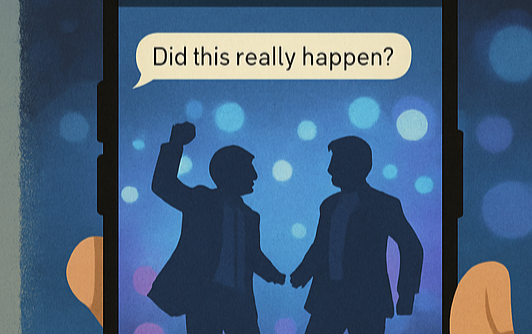
This image was generated by ChatGPT.
“A picture is worth a thousand words”, we’re used to hear. This expression exists in every language, in slightly different versions, but all conveying the same meaning: when it comes to communication, an image is way more impactful than words. And since I don’t believe this is always the case, I would like to restrict the analysis of this idea to one of the possible interpretations of this phrase, related to trust. If for descriptions and storytelling words can sometimes be more beautiful, insightful and memorable, when it comes to demonstration, our human nature pushes us not to believe something fully, until we see it with our own eyes.
In the context of journalism this has always been very important. In the Editorial Codes, Ethical Journalism Handbooks, Codes of Practice of the most popular newspapers we can now find, apart from statements regarding accountability, fact-checking, originality and independence, also paragraphs about Generative Artificial Intelligence and its usage for both text and photojournalism. The New York Time states that “any published images that readers or viewers will understand as depictions of real events or situations must be genuine in every way.” Until a few years ago this only related to the use of photoshop and digital manipulation of photos and videos, but now it also regards a more powerful tool, that of A.I.
I recently had a conversation with a baby boomer, who couldn’t wrap her mind around Sora, and was asking me about its functioning. I tried to share with her the little knowledge I have about generative modeling, but to the typical rhetoric question “Where is this world heading?” I had nothing to add. In fact, the main media sources, fronted by the online versions of the most important newspapers, are facing this change in a responsible manner, preceding what will probably soon become laws on the use of A.I. However, a study by the Reuters Institute from this year shows that around 30% of a global sample use Facebook and YouTube for news each week, followed by around 20% who use Instagram and WhatsApp. This, of course, wouldn’t be a problem per se, if you couldn’t periodically read in the comment section questions such as “Did this really happen?” under content that logically could have never really happened.
And I say so, and not “under content that is evidently A.I.-generated”, because we have reached a point in which it has really become very difficult to distinguish deepfakes from reality. In the previously mentioned study it is also found that more than half of the representative sample is concerned with the problem of distinguishing truth in news online, with 73% in Africa and the United States and 46% in Western Europe. As for the underlying sources of false or misleading information, influencers and national politicians are considered equally the biggest threat worldwide (47%). Of course, A.I. isn’t the only factor at play, but it undeniably contributes to a large extent.
Donald Trump is the perfect example for this matter. Three weeks ago, an A.I. generated video depicting him as a fighter pilot dropping excrements on protesters was posted on his Truth Social account, following the "No Kings" demonstrations against his administration on Saturday, 18th of October. Absurd right? Still functional, if I am talking about it right now. On the other hand, although we tend to perceive them differently because we’re used to encountering them in history books, propaganda posters from the past were at times just as absurd, though they carried a sense of seriousness that today’s equivalents seem to lack.
So, when we look at J. Howard Miller’s “We can do it!” poster from 1943 and at the A.I. video of Trump and Musk dancing to “Staying Alive” by the Bee Gees from 2024, we can ask ourselves if it is representative of the present times or, as everything, it is an experimentation with new tools, which will reach saturation with time. And as the line between reality and artificiality blurs, and the products of our imagination can take a new form with respect to just paintings, do we have to worry or was it the natural course of things all along?
Diana Isnardi is a first year MSc student at Bocconi University studying International Management.
