

Maduro's Capture: What Does the Indictment Actually Say?
By Marianna Calocero | 13th of January, 2026 | 4 min
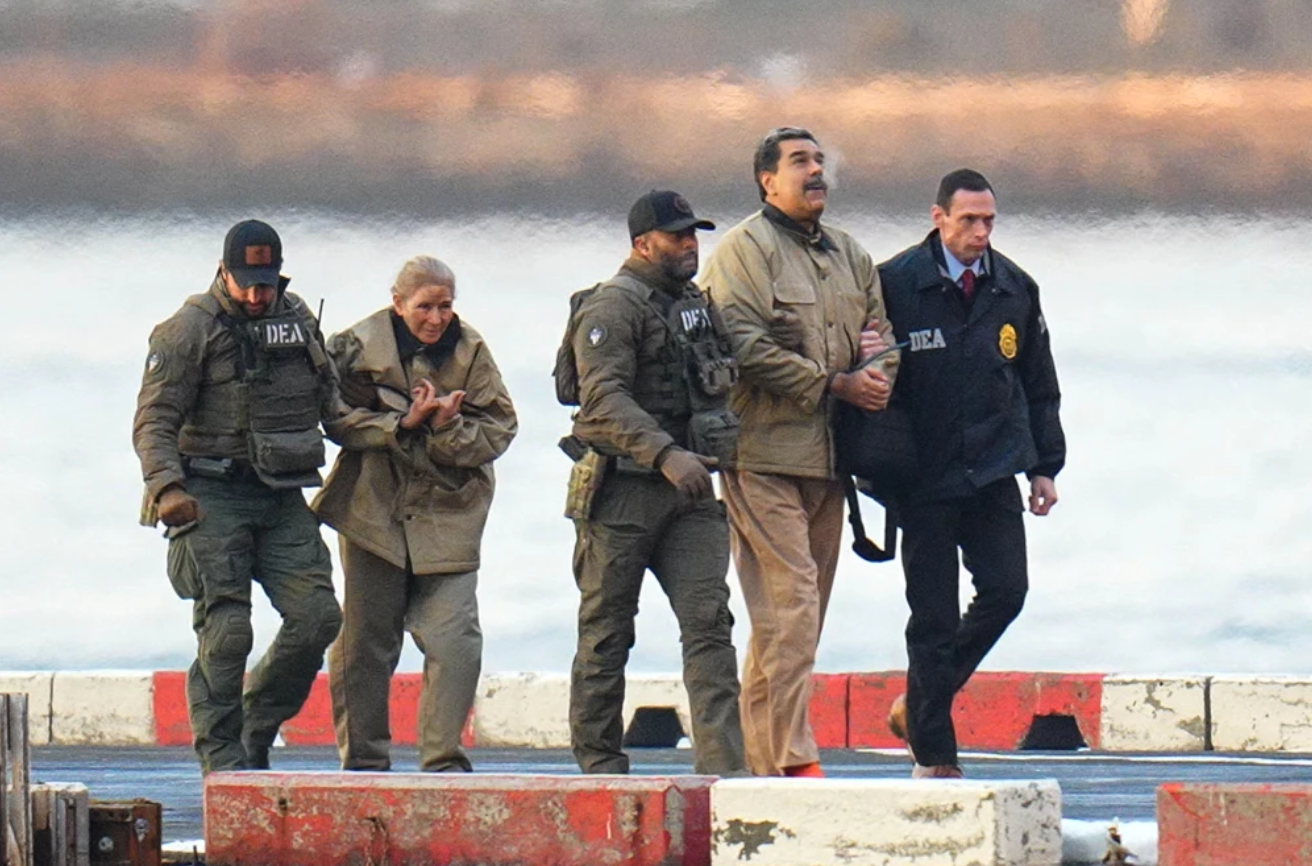
Nicolás Maduro and his wife, Cilia Flores, in handcuffs after landing at a Manhattan helipad.
The recent capture of Nicolás Maduro by US forces and his transfer to New York for arraignment on narco terrorism and related drug trafficking charges marks an extraordinary moment in contemporary international affairs. It is rare for a de facto head of state to be brought before a foreign criminal court on charges that link state structures to large scale cocaine trafficking and support for designated terrorist and criminal organizations.
At its core, the superseding indictment filed in the Southern District of New York advances a simple claim. US prosecutors allege that over roughly a quarter century, senior Venezuelan officials, including Maduro, did not merely tolerate drug trafficking but progressively integrated it into the functioning of the state as part of a criminal-political project aimed at exporting cocaine to the United States. According to the charging document, political authority, military protection, and diplomatic privileges were deliberately used to facilitate the movement of multi ton quantities of cocaine from South America through Venezuela toward international markets, particularly the US.
The indictment places Nicolás Maduro at the center of this narrative, treating his political rise and the alleged expansion of illicit activity as closely intertwined developments. Prosecutors outline a continuity from his time as a legislator, through his tenure as foreign minister, to his period as president, alleging that state resources were mobilized at each stage to provide protection, logistics, and cover for trafficking operations. Among the specific allegations are that, while serving as foreign minister, Maduro sold Venezuelan diplomatic passports to known traffickers and arranged "diplomatic cover" for private jets carrying drug proceeds from Mexico to Venezuela, with embassies instructed to treat these flights as official missions so they would not be inspected.
What stands out in the indictment is the emphasis on institutions rather than isolated individuals. The indictment repeatedly refers to the use of presidential facilities, military controlled airports, and aircraft or infrastructure linked to state entities, including the presidential hangar at Simón Bolívar (Maiquetía) International Airport. In one particularly detailed episode, prosecutors allege that in 2006 more than 5.5 tons of cocaine were loaded by Venezuelan National Guard personnel onto a DC 9 in the presidential hangar before it departed for Campeche, Mexico, where authorities later seized the drugs; bribes were then allegedly paid to protect those involved. Such examples are used to illustrate the broader accusation that, over time, the boundary between state authority and criminal logistics became increasingly blurred.
The indictment also situates Venezuela within a wider regional network of armed and criminal actors. Prosecutors allege long standing cooperation between Venezuelan officials and Colombian groups such as FARC and ELN, as well as ties to major Mexican cartels like the Sinaloa Cartel and the Cartel del Noreste (Zetas), and to Venezuelan organization Tren de Aragua, entities that the US designated as terrorist or narco terrorist organizations in 2025. Domestic criminal organizations, including elements of the Venezuelan security forces, are described as providing security, escorts, and logistical support for shipments transiting Venezuelan territory.
These alleged relationships underpin the most serious charge brought against Maduro: a narco terrorism conspiracy under 21 U.S.C. § 960a, which targets drug tra>icking conduct carried out to provide value or support to designated terrorist organizations. By framing the case in these terms, the indictment characterizes the alleged cocaine trade not only as organized crime, but as a security threat that deliberately leverages terrorist groups and violent cartels to move drugs and to undermine US interests.
From a diplomatic perspective, the allegations matter not only for their technical legal framing, but also for what they suggest about the use of sovereignty as a shield. The indictment paints a picture in which the legal protections normally associated with statehood, such as diplomatic immunity, control over territory, and command of security forces, are alleged to have been instrumentally employed to insulate criminal activities from scrutiny and accountability. According to prosecutors, drug revenues and associated patronage networks helped reinforce political loyalty, sustain security services, and enable the governing elite to resist both domestic opposition and external pressure.
Whatever the eventual outcome in court, the case has already begun to reshape diplomatic debates. It challenges familiar categories used to describe fragile or authoritarian regimes and raises difficult questions about accountability when alleged criminal enterprises are said to be intertwined with formal governance. For diplomats, lawyers, and policy analysts, the proceedings against Nicolás Maduro are therefore about more than the fate of a single leader; they are a test of how international and domestic legal systems respond when the line between state power and transnational crime appears, at least in the eyes of prosecutors, to have largely dissolved.
Marianna Calocero is a fourth year Law student at Bocconi University.
