

Sudan War and UAE’s Involvement
By Giovanni Pazzuconi | 18th of December | 5 min
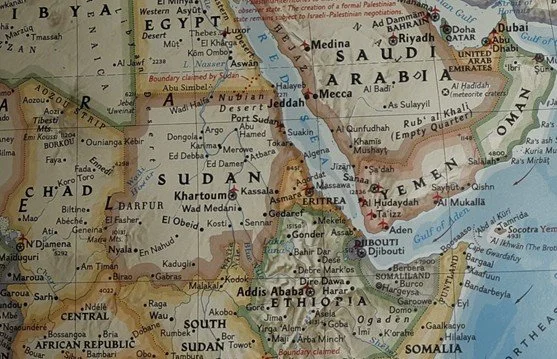
Political map of the region: Sudan and its neighbouring countries.
Source: own picture.
Sudan is currently going through one of its darkest moments. An unprecedented humanitarian crisis, which has displaced approximately 13 million people, has been triggered by violent shootings and extensive massacres that have become daily events in the last 2 years. Since 2023, military clashes have replaced the promising but fragile equilibrium instituted back in 2019. At that time, the long-lasting presidency of Omar Al-Bashir was ended by a joint front of military and civil-society forces.
The fundamental causes behind the internal military divisions and the outbreak of the subsequent war go back well before 2023. Precisely, the thread of these instabilities connects to another open scar in the history of Sudan: the 2003-2005 Darfur genocide. As a matter of fact, one of the two main contenders is de facto still linked to those events. The Rapid Support Forces (RSF) are indeed leading the coalition of the ex-janjaweed fighters. Namely, their soldiers have been recruited from the Arab forces who were the material executioners of the brutal repression campaign in Darfur, which was launched by the government at the beginning of the 2000s.
Eventually, those actions were internationally recognised as an ethnic-based genocide perpetrated against the rebel movements in Darfur, mostly non-Arab tribes. Nowadays, the seed of these past abuses has grown back into a new wave of atrocities hitting these same communities. Fur, Zaghawa, and Masalit ethnicities have been systematically hunted down. As declared on January 7, 2025, by US Secretary of State Blinken, these actions figure as ethnic cleansing crimes, which constitute another chapter of the past genocide. But how did this new conflict erupt, and who is particularly involved in funding it?
In 2019, when Omar al-Bashir was deposed by a military coup, the new commanders pledged to guide the country away from Bashir’s crude inheritance. The new parties at play were the Sudanese Armed Forces, SAF, guided by Abdel Fattah Al-Burhan (Burhan) and the RSF, led by Mohammad Hamdan Daglo Mousa (known as Hemedti). The crucial step to really unify the country was to integrate the RSF into the SAF and divide the military power accordingly. However, for the RSF, losing its own independence implied losing also all the privileges and trafficking accumulated during Bashir’s dictatorship. In other words, Hemedti had to progressively lose the military grip on gold-related activities that had made its clan so rich. At this point, the sequence of events precipitated, and the war erupted across the streets of Khartoum.
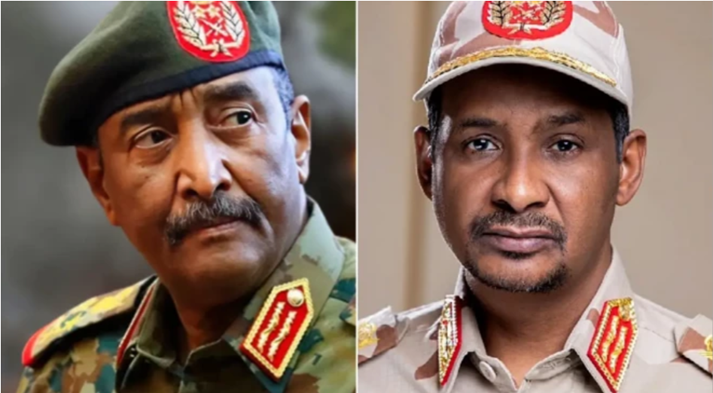
From the left: General Abdel Fattah Burhan (SAF) and Lt Gen Mohamed Hamdan Dagalo (RSF).
Source: Garowe Online.
At first, the RSF were able to confine the government in Port Sudan (on the eastern coast of Sudan), but the Sudanese Army progressively gained strength and pushed the RSF back in Darfur during May 2025. This region, full of gold, oil, and so strategically significant for all the complex geopolitical dynamics along the Nile, started to experience an increasing spiral of violence. To be precise, there were already conflicts going on between the RSF and the main minority group rebels: the Sudan Liberation Army/Movement (SLA/M) and the Justice and Equality Movement (JEM). Indeed, after the massacre of Geneina, capital of Western Darfur, which fell to the RSF in July 2023, El Fasher progressively remained the only SAF stronghold in the region.
Capital of Northern Darfur, El Fasher, became a safe haven for local populations in the region. The RSF imposed on the city a total of 500-day starvation siege, by building a wall around it. In October, the defensive forces had to surrender, and the RSF stormed into the urban centre. Videos, satellite images and official reports suggest that the proportion of mass killings and violence went up to 60,000 people, and still more than 150,000 people are missing, according to the Guardian. The capital of North Darfur became a massive crime scene with piles of bodies heaped throughout its streets, waiting to be burned to mask the evidence. The Guardian defines what is shown by satellite images as ‘a slaughterhouse’.
Henceforth, what seems just like an internal civil war is the outcome of a greater picture, a proxy war where Sudan, and particularly Darfur, is the playing field. The reason is not new: extensive resources and the strategic position on the continent have always been a blessing and a curse for African states. What is really at stake is the gold smuggling business and the control that the Hemedti’s family has on major Darfur mines.
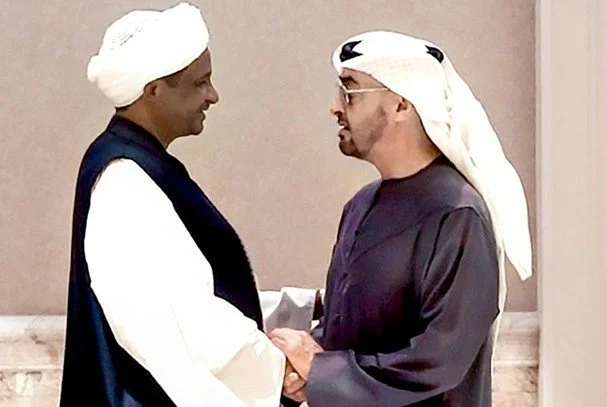
Mohammed bin Zayed, President of the United Arab Emirates, and Hemedti, leader of the RSF.
Source: Watan.
As a matter of fact, the words from Giovanni Falcone, “follow the money and you will find the mafia,” still inspire. The UAE has remained the major destination of gold extracted in RSF-controlled areas, as reported by ISPI. Libya, Chad and South Sudan, but also Egypt, have figured as the main routes of this business. And Egypt is believed to be “the destination of unofficial and smuggled gold exports accounting for about 60% of the production from Northern, River Nile and Red Sea states”. Moreover, even though the SAF tried to divert the UAE as the final recipient of Sudanese gold, evidence shows that, at the end of the day, gold ends up there.
As reported by the NYT and claimed by a UN panel in April 2025, the UAE has become complicit in a deadly double game in which money, weapons and drones are funnelled through the cover of humanitarian missions. Thus, using their medical and aid assistance programs, the Red Crescent, they smuggle weapons and fund the RSF. A UN investigation in January 2024 confirmed that credible evidence supported the Emirates ' guilt of breaking a two-decade arms embargo in Sudan. The Emiratis have been operating under the Red Crescent banner in Amdjarass, across the border in Chad. Indeed, satellite images showed an airport expanded into a military-style airfield, designed to send Chinese-fabricated drones. As declared by Succès Masra, a former prime minister of Chad: “It’s very clear: the UAE is sending money, the UAE is sending weapons.”
Another key proof of Emirates’ involvement in Sudan has emerged from the data leakage of the Somali visa system. As declared by Sudanese ECHO: “Massive Data Breach in Somalia’s E-Visa System Exposes Colombian Passports Linked to UAE Operations Supporting the Rapid Support Militia.” According to reports from Middle East Eye and La Silla Vacía (Colombian outlet), the United Arab Emirates has relied on Somali territory as a logistical corridor to transfer weapons and foreign fighters (some are passports are Colombians) to Sudan. If verified, Mogadishu authorities may also be complicit by turning a blind eye to such transfers.
Thus, the entirety of these findings and the UN reports put forward evidence which rejects the idea of a civil war or a conflict internal to the country. This struggle figures as an ethnic-cleansing operation carried out with either the implicit consent or the actual involvement of powerful external actors, explicitly the UAE. As a last consideration, the Sudanese genocide and the whole proxy war denote the incapability of the international community to effectively intervene. Just a few days ago, a UN convoy was attacked in North Kordofan by the RSF, causing the death of 6 UN peacekeepers. Note that this spring, the Sudanese government accused the UAE of being complicit in the ongoing genocide. However, the trial was dismissed by the ICJ because it was not within the competence area of the court, as reported in the official UAE statement.
In sum, lacking recognition and journalistic coverage, what is happening in Sudan just sweeps under the table without anyone who checks and has the will and the power to do something about it. And this is also the reason why some analysts compare El Fasher’s massacres to the Rwandan genocide, another pillage that could have been prevented, but no one had the intention to do so.
Giovanni Pazzuconi is a first year MSc student at Università Bocconi, studying Economics and Social Sciences.
