

Do We Still Need the UN?
By Maria Letizia Massa | 30th of November, 2025 | 3 min
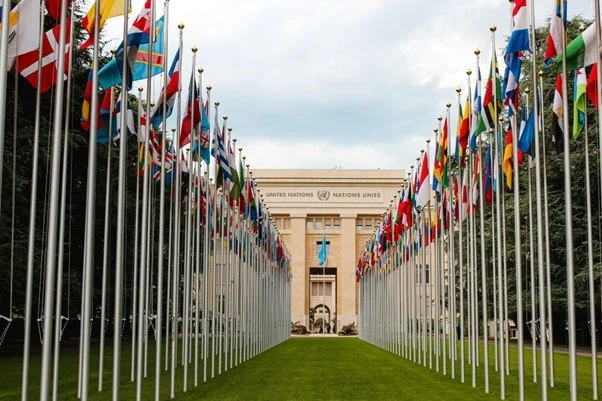
The UN’s Office in Geneva.
Nowadays, in the news, there is a lot of talk about the UN cutting more than 20% of its staff and struggling to address major global conflicts. As political crises and wars persist, many people wonder: is the UN still relevant? Or has the organization that was supposed to prevent wars and humanitarian crises outlived its mandate?
It’s true that the UN now faces a lot of difficulties. Severe financial shortages, caused by delayed payments from member states and especially following the United States’ significant cut in foreign aid, have forced the organization to significantly scale back its operations. The paralysis of the Security Council, where the veto power of several permanent members blocks decisive action, is harming the UN’s credibility. And the broader decline in multilateralism is making cooperation harder just when it’s needed the most. Yet despite these challenges, the world today is facing crises that no country can face alone: climate change, wars, inequality, refugee crises, cyber security threats, the list goes on. The scale of these global problems shows that global governance, and an institution fostering diplomacy and cooperation, are more necessary than ever.
The UN was born in 1945, in the aftermath of the Second World War, with a clear but ambitious mission: to prevent another world war. While wars unfortunately are still happening, the UN’s impact on world peace is undeniable. Indeed, 80 years after its creation, there has not been a third world war (not to jinx it!). But the role of the UN does not stop there. Beyond peacekeeping, it has mediated hundreds of conflicts, provided humanitarian aid to millions, and helped establish international law. The Universal Declaration of Human Rights, proclaimed in 1948 by the UN National Assembly, was a milestone that paved the way for more than 70 treaties protecting human rights worldwide. The International Court of Justice, another UN creation, plays a crucial role in ensuring compliance with international law and resolving disputes between countries peacefully.
Critics are often very quick to list the UN’s shortcomings, including the invasion of Ukraine, the wars in Syria and Yemen, or the fact that the UN has never had a female leader. While these are serious failures and should not be ignored, they reveal only one side of the story. It’s equally important to recognize the essential work the UN does, often away from the spotlight. UN agencies like the World Food Programme, UNICEF, and the World Health Organization fight every day against hunger, inequality and lack education and healthcare, providing vital aid to millions. During the COVID-19 pandemic, the WHO was on the frontline coordinating cooperation and information sharing. In crises zones, UN agencies are often the first to arrive and the last to leave and offer crucial humanitarian support. The UN also plays a crucial role in setting the long-term global agenda, in particular, the 2030 Sustainable Development Goals, which provide a framework for countries to align their efforts on climate change, education and inequality.
That said, it goes without saying that the UN must change. Reforms are necessary to tackle the challenges of the 21st century and to ensure that the organization remains fit for the purpose it was created for. The composition of the Security Council reflects the composition of countries in 1945, and not that of 2025, with Asia, Latin America and Africa still underrepresented in decision-making. Financial dependence on a few large donors leaves the organization vulnerable to political pressure, as the recent cuts of US-Aid have shown. Moreover, the Security Council’s paralysis makes it clear that the current decision-making process cannot respond effectively to emerging crises. Change is fundamental, requiring bold institutional reforms and new ways of thinking.
And luckily change, thought difficult, is not impossible. The UN has undergone major changes before, incorporating more countries and expanding beyond its original peacekeeping mandate to take on new global challenges such as climate change, inequality and pandemics. Previous crises have forced the UN to adapt, and the same must happen now. Abandoning the UN is not the answer. Doing so would not lead to faster and fairer responses to humanitarian crises, but to increased nationalism and competing national interests. In today’s interconnected world, multilateralism is a necessity. The UN, though far from perfect, remains the only place where every country has a voice and where contrasting visions are mediated to achieve common goals. The real question, then, is not whether we still need the UN, but rather how we can make it stronger, fairer and better equipped to keep on addressing the challenges of our time.
Maria Letizia Massa is a first year MSc student at Bocconi University studying Management of Government and International Organizations.
