

Canada’s Weak Spot: How Alberta Can Become America’s Golden Ticket
By Marianna Calocero | 4th of December, 2025 | 6 min
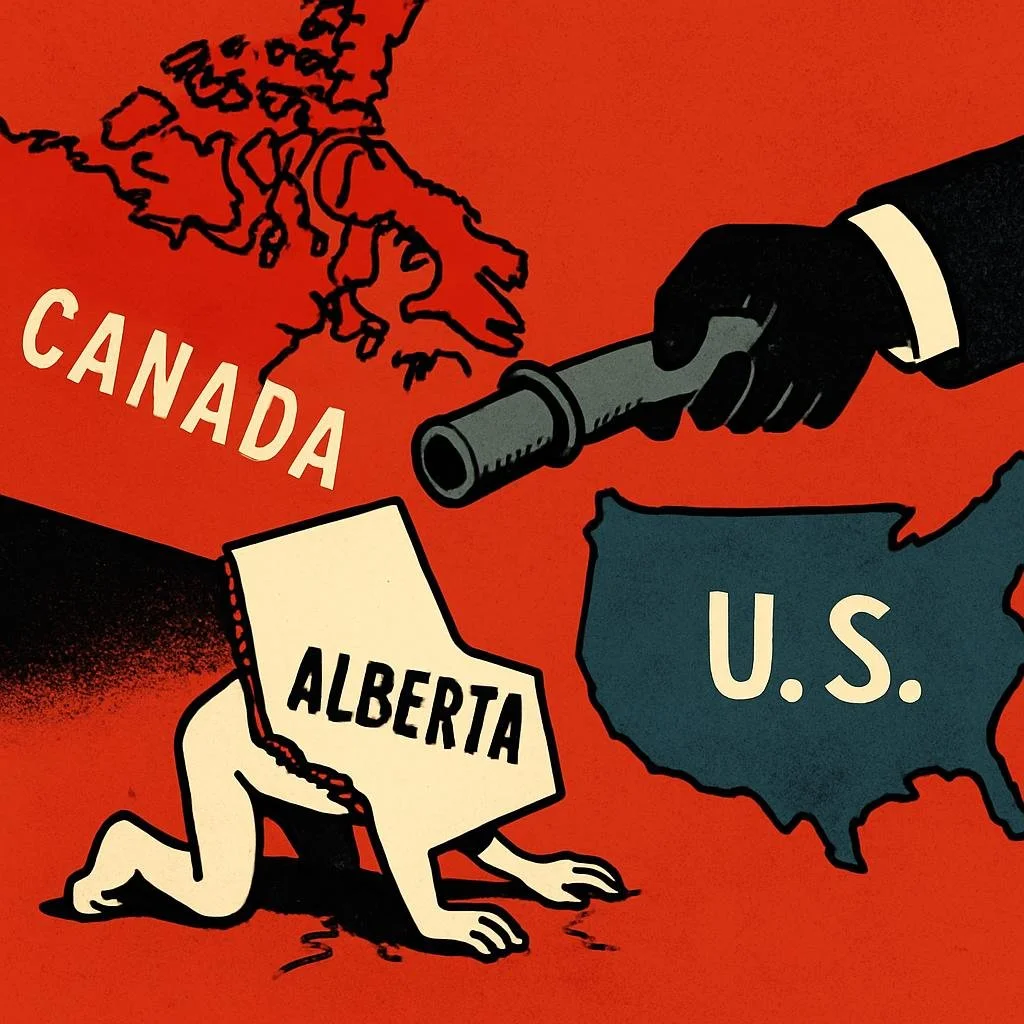
This image was generated by ChatGPT.
President Trump has become the most controversial public figure in the Western world, and, as every news outlet has repeated for months, this seems to be precisely his goal. As the saying goes, “any press is good press” whether he is discussed positively or negatively, he counts it as a victory.
But beyond what the world may say, we need to take a closer look at a borderline cartoonish narrative he has built and the consequences it carries. This is no easy feat, especially given his chaotic presence in the media, the overwhelming stream of news coverage, and the paralysis of public engagement. But one conversation has been overshadowed: the highly polarising “51st state” debate.
Mr. Trump, during the first months of his presidency , repeatedly stated that Canada should and will become the 51st state of the United States of America, going as far as not denying potential military intervention. Ever since Canada refused to join its neighbour in the fight for independence against the Crown, the relationship between the two has been – some might say – dysfunctional. The two countries even went to war with each other. In 1812, the U.S. invaded Canada, expecting to be greeted as liberators; instead, they were faced by British regulars and Canadian militia who proceeded to march all the way down to Washington and burn the White House, a detail that, somehow, is often proudly recalled by Canadians but conveniently omitted by Americans. The aftermath of the war would have been negligible, aside from U.S.’s embarrassment, were it not for a lingering sense of existential anxiety on the northern side of the border and the looming fear, reinforced by the President’s current rhetoric, of being invaded again and ultimately annexed.
Historically, any time the Americans had a spasm of expansionist delirium, whether under the spell of Manifest Destiny or the “54-40 or Fight” slogan, the territories that would one day become Canada would get nervous and latch onto the UK’s skirt, pulling out the big guns from across the ocean to deter any colonial venture along their shared border. But after 1945, just like the rest of Europe, Great Britain was on the verge of financial collapse. Meanwhile, the U.S. had just established itself as a new superpower, and Canada quickly realised that it had lost back-up from across the ocean and had to find a way to defend its sovereignty. That’s when a marriage of convenience began between the two; the U.S. was busy fighting endless wars, beating Russia in a rocket race, and eavesdropping on its neighbours down south. The U.S. had bigger problems and global priorities, so conquering Canada was the last thing on their mind, and Ottawa benefited from that neglect.
Yet the reality was that this stability was merely apparent and extremely fragile, because it depended entirely on the will of the U.S. And even today, Canada remains heavily dependent on the superpower next door: over 90% of Canadians live within 160 km of the border, more than 75% of its exports go to the U.S., it participates in every American-led defence initiative, and it has fought in every single American war except Vietnam. Canadians know they rely heavily on the United States and are also quietly influenced by it, which is why they hold tightly to their cultural and political sovereignty. Radios forced to play a certain percentage of Canadian music, the quick and early legalization of every possible liberal agenda, and the minting of Canadian dollars, in clear defiance to the american equivalent, are just some of the national survival strategies Canada deploys to convince the world, and possibly itself, that it’s not just America’s roommate. Pierre Trudeau (Justin Trudeau’s father) famously said, “Living next to the U.S. is like sleeping with an elephant. No matter how friendly and even-tempered the beast, one is affected by every twitch and grunt”. Canadians are very much aware that if Mr. Trump wakes up on the wrong side of the bed, he could easily conquer one of the widest countries in the world, from Vancouver to Montréal, in a matter of weeks.
But Canada’s desire to stand as a fully independent nation proved insufficient; when a bolder president took office, one notably lacking diplomatic skills in the traditional sense, Canada rattled. Within weeks, Justin Trudeau lost credibility, some of the highest tariffs from the White House reached Canadian steel, and persistent jokes about the “51st” state jolted Ottawa, which had to keep up, most of the time, a friendly face so as not to enrage President Trump.
But apart from the foreseeable consequences of Mr. Trump’s words, the shock of the Europeans, and the Canadians’ scramble to find the best way to retain their sovereignty, not many have considered that Trump was actually talking to someone other than foreign leaders. If Trump’s comments about Canada’s annexation had been directed at Ottawa, their potential would have vanished even before the words left his mouth, since the only possible and reasonable Canadian answer would have been “no thanks.” But Canada is a peculiar country: out of 10 provinces, only 6 have real political relevance, and among these few, polarization is thriving. Culture, language, the job market, habits, and values shift drastically from province to province, severely undermining the country’s unity. When some Canadians cannot even understand each other due to language barriers, how can a strong defence against Washington be built? It can’t.
And through these cultural cracks, Trump has infiltrated himself. It could look like a dam leak, an unnoticeable hairline seepage that appears harmless to the world yet keeps flowing until pressure builds and the structure fails catastrophically. But where is the ultimate fissure that could make Canada collapse? On the eastern border of British Columbia, separated by the most majestic mountains I have ever seen, lies Alberta, a province rich in oil, gas, and mega-farms. Albertans are the archenemies of British Columbians and Ontarians, blue-collar workers, used to the cold and harsh work conditions, with conservative values and a strange pride in being called “rednecks”. Yet Alberta is the economic backbone of Canada. The province has become a net contributor to equalization programs, effectively subsidizing eastern and central provinces, a resentment reflected in the fact that nearly 60% of Albertans support removing the equalization principle from the Constitution.
The financial exploitation of Alberta is no joke to the province. Federal restrictions on oil and gas, along with the latest obstruction by Canada’s current prime minister, Mark Carney, of a pipeline that would link the province to the Pacific and bring in billions of dollars in international investment, is one of the main triggers of separatist talk in the region. Alberta’s conservative leanings and its sense of being underrepresented in Ottawa often clash with federal progressive policies on the environment, guns, immigration, and carbon taxation.
These dynamics all converged in what can only be called a Wexit movement: a desire for separation or autonomy that would bring significant repercussions for both Canada and Alberta. Parties such as the Independence Party of Alberta (although short-lived), the Wildrose Independence Party of Alberta, and the Republic Party of Alberta show clear support for the province’s full independence. The mainstream United Conservative Party, under Premier Danielle Smith, the current governor of Alberta, does not publicly endorse such an agenda but uses separatist rhetoric as leverage. However, the UCP, just one day after Liberal Prime Minister Mark Carney’s federal election victory in April, introduced Bill 54, the Election Statutes Amendment Act, which lowers the barrier to a provincial referendum on sovereignty, accelerating Alberta’s already-simmering separatist movement. The bill reduces the threshold for citizen-initiated referendums from 20% of all eligible voters to just 10%, making referendums roughly 70% easier to trigger. As of late 2025, between 20% and 30% of Albertans say they would vote yes in a referendum, with many younger Albertans showing a strong interest in voting in favour of independence.
Although separatism is more mainstream than ever, it remains far from a majority movement, largely because there is not yet any active planning for independence. The legal hurdles for a unilateral separation are massive, the economic analyses warn of potentially severe fallout if independence were pursued, and mainstream conservatives like Smith tend to channel public grievances into demands rather than an actual exit. Still, one must ask whether Mr. Trump’s remarks, which have clearly fueled separatist sentiment, might contribute significantly to an eventual independence process in Alberta. Perhaps Mr. Trump’s objective is not literal annexation, which would place a disproportionate burden on Washington, but the strategic destabilization of the region — loosening Alberta’s ties to Ottawa and placing the province’s resources within arm’s reach. In such a scenario, access to Alberta’s, and potentially other provinces’, vast natural resources would no longer require diplomacy, only opportunity.
Marianna Calocero is a fourth year Law student at Bocconi University.
