

The Quiet Expansion of Executive Power Through ‘Emergency’ Laws
By Lupita De Smet | 17th of April, 2026 | 7 min
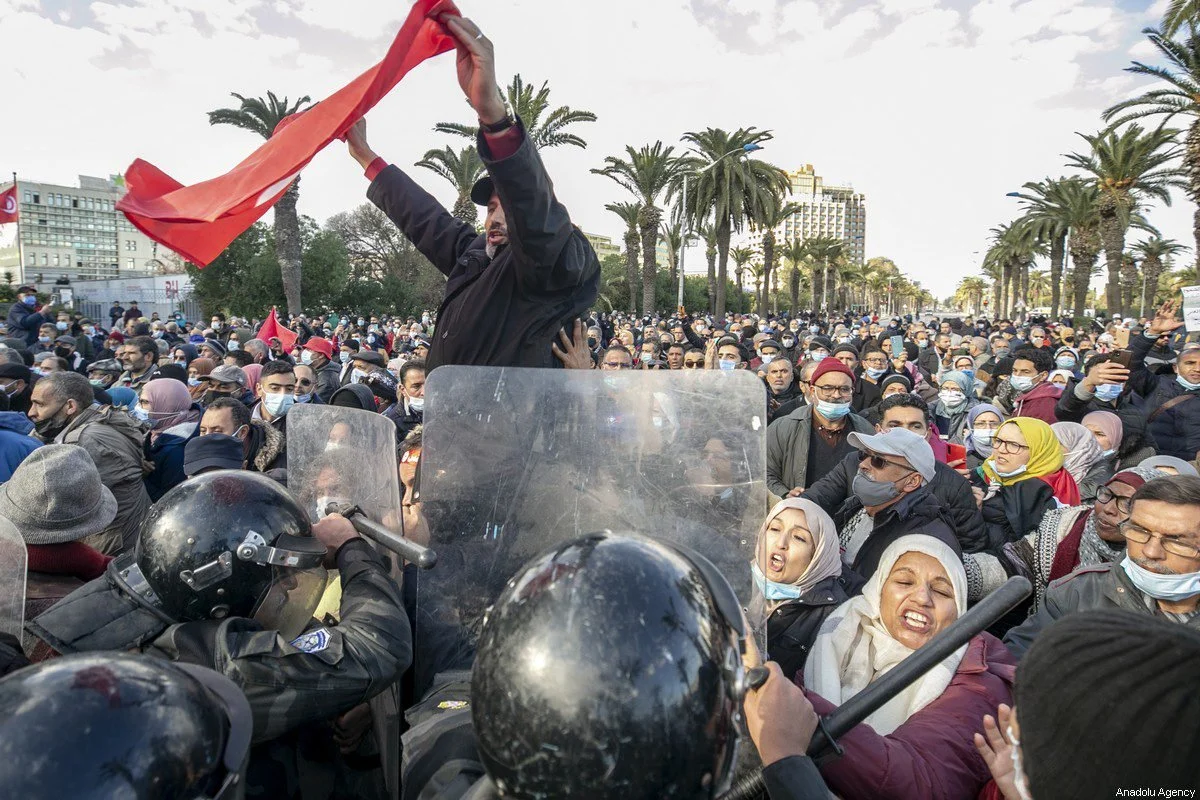
Tunisians clash with security forces during a demonstration against President Kais Saied, on the 11th anniversary of the Tunisian revolution in the capital Tunis on January 14, 2022.
President Yoon Suk Yeol's sudden declaration of martial law in South Korea in 2024 shook the international community. Whilst Article 77 of the Constitution of the Republic of Korea grants the President power to declare martial law, there were no indications regarding ‘war, armed conflict, or similar national emergencies’ required by the Constitution in order to do so. Though this unconstitutional declaration of emergency law was quickly and democratically resolved in South Korea, it reflects a broader global trend towards the use of emergency laws as more durable mechanisms of governance, as opposed to temporary tools of crisis litigation. This ‘executive drift’ towards emergency laws has been accelerated by events such as the COVID-19 pandemic, terrorism, and economic crises, whereby executive branches increasingly rely on emergency measures to manage crises, bypassing legislative oversight and weakening liberal democratic principles such as the protection of civil liberties and democratic accountability. But what happens when emergency laws become the default mode of governance, and how can executive power preserve its flexibility without eroding accountability?
The convergence of exception and normal governance
Emergency laws are typically grounded in a state's constitutional framework to enable governments to temporarily expand their powers during crises. This creates what is formally known as a ‘state of exception’, whereby normal legal rules are suspended or bypassed, and the fundamental rights of citizens can be broadly restricted to maintain order and national security. As such, a state of emergency, while necessary, risks that temporary suspensions of democratic principles and civil liberties become the gateway to a permanent expansion of executive power and restriction of human rights. Paradoxically, emergencies may therefore facilitate the destruction of the democratic values they exist to preserve. In an attempt to constrain the executive branch and prevent its abuse, emergency powers are formally exceptional, time-limited, and legally constrained. However, in practice, States have repeatedly renewed emergency declarations or embedded emergency provisions into ordinary law, in order to expand and entrench their power beyond what is necessary to handle the emergency. For example, President Zelensky has repeatedly ruled martial law in Ukraine since the Russian invasion in February 2022, which has resulted in the postponement of elections that would have marked the end of his five-year term in May 2024. Whilst the Russo-Ukraine war presents a legitimate security threat to invoke a state of national emergency, the prevention of the regularly scheduled presidential election from being conducted raises questions of democratic accountability, and whether this undermines the foundational democratic principle of free and fair elections and electoral turnover. Furthermore, in January 2026, Zelensky declared a state of emergency in the energy sector, following sustained Russian attacks on infrastructure, stating that this would allow authorities ‘more options and flexibility’ to deal with the aftermath of the attacks. This additional expansion of executive control over critical infrastructure and decision-making processes further reinforces a structural shift, whereby the distinction between exception and normal governance is gradually fading.
Similarly in Tunisia, President Kais Saied has issued a continuous state of emergency since 2015, initially justified to counteract the political instability that ensued an attack in which several presidential guards were killed. This included measures such as expanded surveillance powers and accelerated legislative procedures. However, this exceptional governance has since been institutionalised into normal governance. In 2021, President Kais Saied suspended the parliament, and the following year rewrote the constitution, replacing the 2014 democratic charter with a new version that grants himself immense power. In doing so, he has enabled lasting constitutional change, reflecting the broader shift towards the use of emergency laws as more durable mechanisms of governance.
The fragile balance between liberty and security
In International Law, jus cogens norms are peremptory principles from which no derogation is possible, binding all States regardless of consent. Examples of such norms include prohibitions against genocide, torture, and slavery. Yet, the expansion of executive authority in a state of emergency and the resulting reduction in judicial oversight creates conditions in which such safeguards may be undermined in practice. This ‘executive drift’ increases the risk of abuse, such as arbitrary detention and the excessive use of force, which in extreme cases, can lead to serious violations of fundamental human rights. For example, in El Salvador, a state of exception was introduced in 2022 to combat gang violence, and has remained in force through repeated extensions. Under this framework, executive and security power has expanded to enable mass arrests of more than 89,000 individuals, as well as suspending their due process rights. While these measures were originally justified to restore public safety amidst extreme crime rates, they have invoked new, and perhaps more serious threats. According to the ICJ, the systematic and widespread violations committed pursuant to El Salvador’s security policy may constitute crimes against humanity under international law, raising concerns that such practices may approach breaches of jus cogens norms. Furthermore, the limited access to legal remedies has not only dramatically reduced individual liberties, but has disproportionately affected marginalised communities, exposing how the liberties of the few can be traded off too quickly against the security of the many. Accordingly, what was initially framed as a temporary emergency has over time evolved into a semi-permanent system of governance, which has resulted in the wrongful detention of thousands of individuals, including at least 8,000 acknowledged by President Nayib Bukele’s public admission to be innocent.
Conclusion
Democratic governance relies on the predictability of legal norms, the accountability of public authorities, and the effective limitation of political power. Whilst emergency laws are necessary for democratic constitutions to effectively respond to emergency situations, the persistence of these powers beyond the emergency context threatens the constitutional order they initially intended to safeguard. Masked under flexible concepts such as national security, public order, and risk management, the erosion of rights in a democratic system does not occur through outright authoritarianism, but rather subtly within the boundaries of legality itself. Ultimately, as the distinction between exception and normal governance fades, legal systems must anticipate clearer boundaries, not to alter the temporary suspension of rights during moments of crisis, but to prevent the gradual normalization of exceptional governance practices, preserving the flexibility of executive power without eroding its accountability.
Lupita De Smet is a 2nd-year International Politics and Government student.
