

The Laws of War are Breaking Down – Does Anyone Care?
By Hayden Caty | 1st of April, 2026 | 6 min
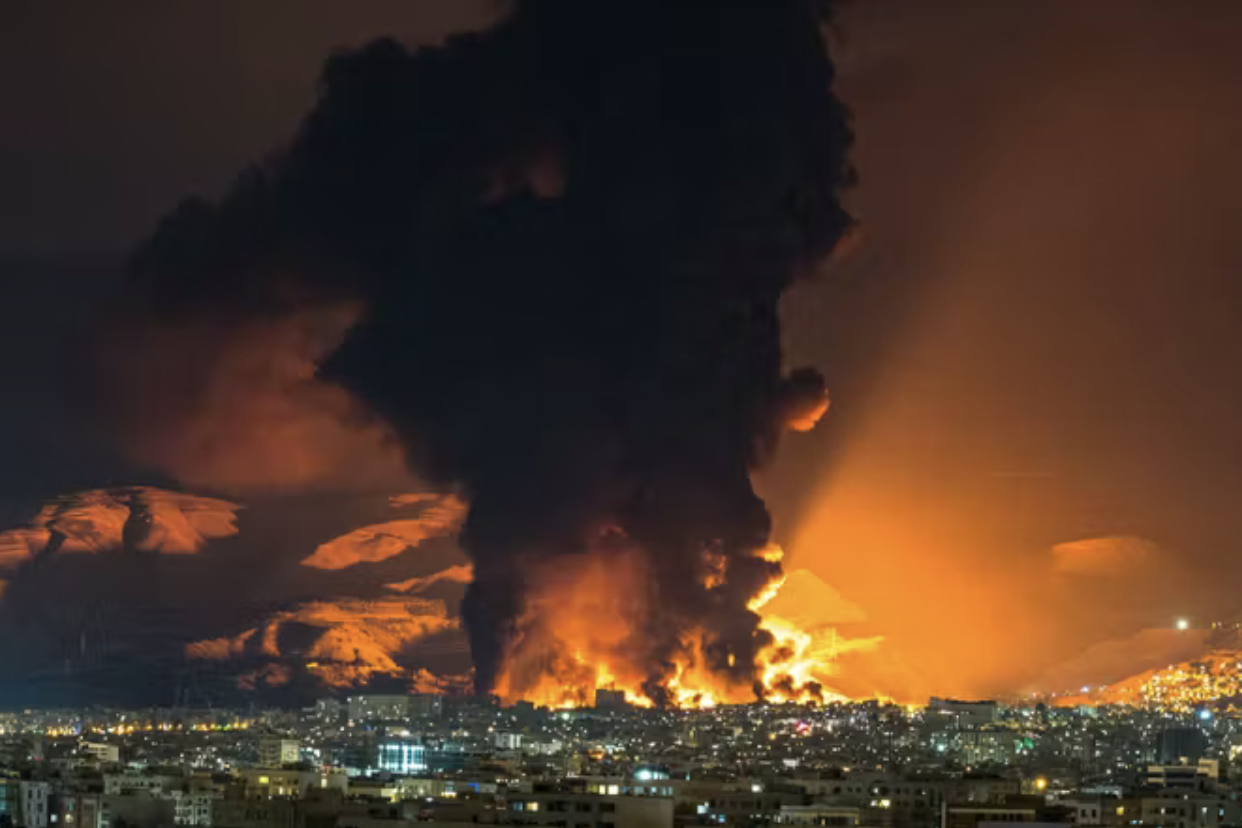
Smoke rises over Tehran as strikes continue
On February 28, 2026, a US airstrike hit Shajareh Tayyebeh girls' primary school in Minab, Iran, killing between 175 and 180 people, many of them children. The building was struck three times. Investigations by the New York Times, BBC Verify, NPR, and CBC all identified the United States as responsible; the US military's own internal inquiry reached the same preliminary conclusion. The official explanation was outdated targeting data, with the intended target an adjacent IRGC facility. The event stands as the deadliest civilian strike of a war marked by documented violations on all sides, with no legal consequences for any of them.
International humanitarian law (IHL) sets binding obligations on all parties to conflict. At Minab, those obligations have been widely recognized as violated. IHL rests on three principles: distinction (separating civilians from combatants), proportionality (civilian harm cannot be excessive relative to military advantage), and precaution (all feasible steps must be taken to verify targets and minimize harm). UNESCO called the strike a "clear violation" the day it occurred. The UN Secretary-General condemned it. Amnesty International argued the US "could and should" have known civilians were at risk. Precaution is what makes distinction and proportionality meaningful. If a state can rely on outdated data, kill children, conduct a self-investigation, and face no consequence, then precaution is effectively unenforceable. Minab exposes a gap between what the law requires and what it can compel.
Responsibility, however, is not limited to the United States but reflects a broader systemic failure. By the tenth day of the war, Iran had launched 300 missiles at Israel, nearly half carrying cluster submunitions widely condemned as inherently indiscriminate. Iranian strikes also hit civilian infrastructure in Gulf states, including a desalination plant and residential areas–all protected under IHL. At the same time, airstrikes attributed to US-Israel operations targeted Iranian desalination facilities supplying civilian populations. Analysts warned that continued attacks on such infrastructure could trigger a massive humanitarian catastrophe. When all major belligerents violate core rules without consequence, the issue is not isolated misconduct but structural limitation. IHL is weakest where it is most needed: conflicts involving major powers.
A further dimension of the Minab strike remains unresolved. Credible reporting indicates Pentagon targeting in the Iran war relied heavily on AI-assisted tools. IHL requires human judgment in lethal decisions, with accountability tied to individuals under current legal interpretation. AI systems diffuse that responsibility in ways existing law is not equipped to address. If an algorithm processes outdated data and recommends a strike that kills schoolchildren, it is unclear who is legally or politically responsible. The Iran war is the first major conflict where this question is urgent rather than theoretical, and the law has no settled answer.
Despite extensive documentation and near-universal condemnation, accountability mechanisms have produced nothing. The UN Security Council is deadlocked; the US holds a veto and will use it. The ICC lacks jurisdiction over the US and Israel, and Iran has not cooperated with international investigators. Domestic oversight is minimal; Congress did not authorize the war and has had minimal visibility on targeting criteria. Meanwhile, Secretary Hegseth has openly endorsed "more lax rules of engagement," signaling that reduced civilian protection standards are not oversight but policy. The post-war international legal order was designed by great powers, with sufficient side-steps that those great powers could never be meaningfully held to account under it.
Refugees International has described the Minab strike as likely the deadliest US action involving children since My Lai in 1968. My Lai eventually led to prosecutions, congressional hearings, and reforms, driven by sustained public pressure. Whether Minab produces anything similar depends on whether it is treated as a violation or accepted as precedent. The laws of war have not collapsed overnight; they have eroded through repeated violations and tolerated impunity. The 2026 Iran war has accelerated that erosion to a breaking point.
Hayden Caty is a 1st-year International Politics and Government student.
