

The Iran & US-Israel War Explained - The Legality Question and the Transatlantic Tensions
By Ines Bellumore | 27th of March, 2026 | 7 min
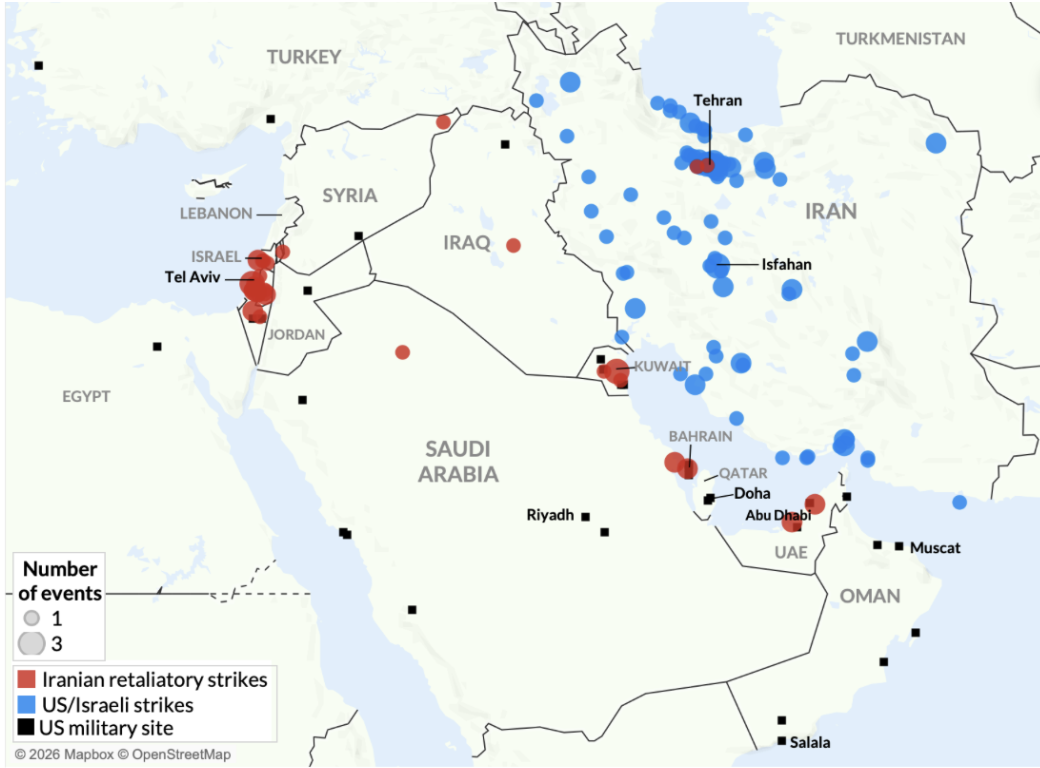
Map of the US-Israeli and Iranian strikes across the region as of March 21st 10:00 AM (ISPI)
This article does not aim to take a side in the conflict or express an opinion. Its sole purpose is to provide a clear and factual overview of recent events as well as analyse the legality of the conflict and its possible consequences on transatlantic relations.
As the conflict continues, significant debate has emerged regarding its legality under international law.
Several states, including early supporters such as the United Kingdom, have begun to distance themselves from the positions taken by the United States and Israel.
At the core of the debate lies a fundamental question: can the use of force in this case be justified as self-defence?
Under Article 51 of the United Nations Charter, states have the right to self-defence only in response to an armed attack, or in the presence of an imminent threat. Any other use of force must be authorised by the UN Security Council under Chapter VII.
The United States and Israel have justified their actions on the basis of preventive or anticipatory self-defence, arguing that Iran’s alleged nuclear ambitions constituted an imminent threat. However, this justification remains highly controversial on the international stage.
It has been argued that the existence of an imminent threat has not been clearly demonstrated, the strikes may therefore constitute a prohibited use of force. Furthermore, the doctrine of pre-emptive war, particularly as articulated in the early 2000s under former US President George Bush, is not widely accepted as lawful under international law.
This controversy was further amplified when U.S. Secretary of State Marco Rubio described the strikes as pre-emptive, a characterisation that weakens the legal argument under prevailing interpretations of international law.
Domestically, the legality of the war has also been questioned within the United States. The Constitution grants Congress the authority to declare war, yet Congress appears to have played only a limited role. Lawmakers from both parties have expressed concern over the lack of clear justification provided prior to military action.
Finally, inconsistencies have been noted between the administration’s actions and its own prior strategic assessments. The November 2025 National Security Strategy suggested that Iran no longer posed an immediate threat, raising further questions about the necessity and proportionality of the intervention.
Beyond its immediate military and legal implications, the conflict is likely to generate significant political tensions between the United States and its European allies, with potential long-term consequences for NATO cohesion.
From the outset, European reactions have been notably divided. While some states, such as the United Kingdom, initially offered conditional logistical support, others, including Spain and, more cautiously, France and Germany, have emphasised the need for de-escalation and strict adherence to international law. This divergence reflects a broader structural tension within the transatlantic alliance.
At the heart of the issue lies a difference in strategic culture. The United States has demonstrated a willingness to engage in rapid, unilateral military action, justified by a broad interpretation of self-defence. In contrast, the European Union has consistently framed its response around multilateralism, legality, and diplomatic resolution. This contrast risks deepening an already visible gap in how both sides perceive the use of force in international relations.
NATO, as a collective defence organisation, may also face institutional strain. The alliance is built on the principle of mutual defence under Article 5, which applies only in response to an armed attack against a member state. In this case, however, the United States appears to have initiated hostilities alongside Israel, raising questions among European members about the extent to which NATO structures and resources should be involved in a conflict that lacks clear defensive justification.
Furthermore, the use of European military bases by U.S. forces has become a point of contention. While some governments have permitted limited access, others have refused outright, reflecting domestic political pressures and legal concerns. This asymmetry risks undermining operational unity within the alliance and could lead to fragmentation in future crisis responses.
The conflict may also have broader geopolitical consequences for the European Union. Faced with the prospect of regional escalation, including threats to energy routes, migration flows, and internal security, EU institutions have reiterated their commitment to a rules-based international order. However, repeated instances of unilateral action by close allies risk weakening the credibility of this framework and may push the EU to pursue greater strategic autonomy, particularly in defence and foreign policy.
Finally, tensions could emerge at the economic and diplomatic levels. Disagreements over sanctions, trade measures, and relations with Middle Eastern actors may further complicate transatlantic cooperation. Public opinion within Europe, which has generally shown greater skepticism toward military intervention, could also place additional pressure on governments to distance themselves from U.S. policy.
In the longer term, the conflict may not lead to a formal rupture within NATO, but it is likely to expose and deepen existing fractures. The extent to which these tensions evolve into lasting divisions will depend on the trajectory of the war and the willingness of both sides to re-align their strategic priorities.
Ines Bellumore is a 2nd-year Global Law student.
