

The American “Hit List”: Afghanistan, Iraq… and Now Iran? Or a Different Kind of Conflict?
By Liam Smith | 3rd of April, 2026 | 7 min
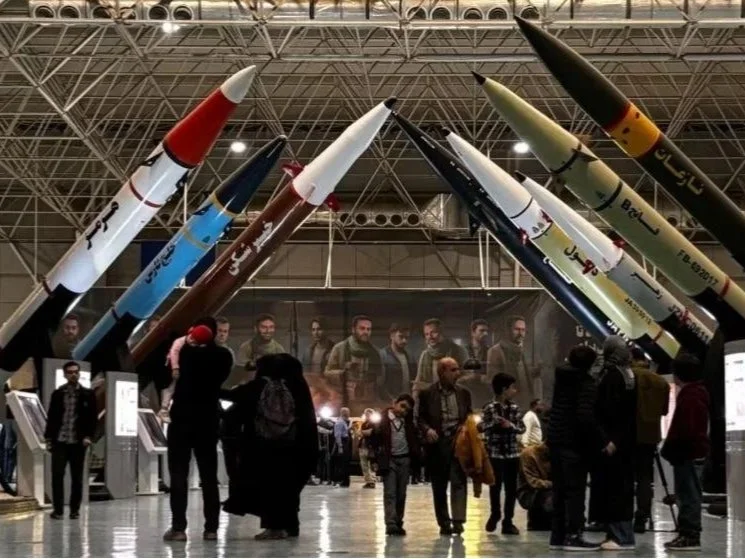
A showcase of the Iranian missile arsenal outside of Tehran, late last year
The U.S. strikes on Iran on February 28 mark the third time in the past 25 years that the United States has militarily intervened in a country in the near region. In 2001 U.S. troops began airstrikes on Afghanistan, which eventually escalated to the full-scale invasion toppling the Taliban and initiating 20 years of war and instability in the country. Two years later, in 2003, the Bush administration began “Operation Iraqi Freedom”, the invasion of Iraq, which resulted in the collapse of Saddam Hussein’s regime, in addition to an 8-year on-the-ground conflict.
On a superficial level, the U.S. intervention in Iran may feel like déjà vu. The invasions of Afghanistan and Iraq also began with airstrikes before escalating to broader military combat. Moreover, the public justifications for the interventions seem to mirror one another, with each being framed as a necessary response to an “imminent threat”. In each conflict, the U.S. has touted itself as a guarantor of global security, seeking to pacify perceived hostile threats through aggressive “shock and awe” campaigns. In the cases of Iraq and Afghanistan, intervention led to the fall of the then-governments, ostensibly achieving the American goal.
Political analysts, news outlets and netizens alike have been quick to point out the parallels of these past conflicts, hypothesising what it could mean for Iran. However, these comparisons obscure two fundamental realities that will shape the way this conflict looks. Firstly, Iran possesses far greater demographic, economic, military power than its neighbours, and has more leverage than Afghanistan or Iraq on the global stage. Secondly, the zenith of U.S. influence has arguably waned since the early 2000s, reducing the degree of uncontested American dominance.
Iran’s demographic and economic profile should be examined against Afghanistan and Iraq to understand how this conflict is fundamentally different. Iran is a demographic giant in the Middle East: while Afghanistan’s population stood at roughly 21 million in 2001 and Iraq’s at 24 million in 2003, Iran’s population reached over 91 million in 2024, making it the most populous country in Western Asia. This scale goes far beyond numbers, as it underpins increased economic complexity, a deeper labour pool and a greater capacity for enduring militarization. In essence, Iran has a level of internal resilience that neither Iraq nor Afghanistan had, making it significantly more difficult for the United States to decisively weaken the country.
The Iranian economy is large and planned, in stark contrast to Afghanistan’s, which relied mostly on small-scale agriculture and informal economic activity. Unlike Iraq, whose government derived around 98% of its revenue from petroleum exports around the time of the 2003 invasion, Iran’s economy is diversified and more globally integrated. Though oil exports are one of the largest industries in Iran, significant automotive manufacturing, mining and agriculture also contribute meaningfully to national output and government revenue. Furthermore, Iran’s energy infrastructure remains largely intact, while Iraq entered its conflict in an already weakened position, with sustained damage to infrastructure as a result of the 1991 Gulf War. Iran’s position is further strengthened by its role as a key energy supplier to significant consumers, including China, which accounts for around 90% of Iranian oil exports, representing 13.4% of Chinese imports.
China’s reliance on Iranian oil indicates a broader shift that could reshape the dynamics of any conflict involving Iran. The global economy is no longer firmly anchored in U.S. dominance, as it was during the early 2000s; instead, China has risen as an equal global power, with significant economic and geopolitical reach. Given the crucial trade relationship between China and Iran, as well as China’s existing rivalry with the U.S., exacerbated by tariff escalations since Trump’s second term, many states may be more hesitant to align fully with U.S. intervention. Rather than risk jeopardizing relations with China, countries may seek to hedge their positions. This has already been illustrated, as traditional European allies, such as Spain, have outright refused to militarily support the U.S. in the conflict. In contrast to the invasions of Afghanistan and Iraq, which unfolded in a more unipolar environment with more cohesive support for U.S. action, the confrontation involving Iran is escalating before a more fragmented international backdrop.
One of the cruxes of the conflict is access to the Strait of Hormuz, a crucial shipping passage, which connects the oil-producing countries of the Gulf, including the UAE, Qatar and Kuwait, to the Indian Ocean. Iran has already closed the Strait to all but Iranian petroleum exports. This gives Iran far more bargaining power than Afghanistan or Iraq ever had, neither of which held any geographic position to truly disturb global trade routes. Data shows that oil exports have already dropped 60% from the Middle East as a result of disruptions. As such, the U.S. will have to approach this conflict much more delicately than its previous interventions in the region, as disruption at Hormuz could cause a surge in global oil prices, which has the potential to further compromise any support from other states for U.S. action.
Additionally, the potential impacts the conflict could have on the Iranian regime should be analysed. In Afghanistan and Iraq, the respective regimes were quickly toppled as a result of American intervention. However, in Iran’s case, the regime is institutionalised and centralised. In 2003, the then Iraqi political authority was quickly destabilised and fractured after the capture of Hussein by American forces. Meanwhile, in rural, mountainous Afghanistan, the Taliban regime did not have a strong grip on central power, and retreated into the country’s hinterlands. In Iran’s case, the death of the Ayatollah may not signify the all-out collapse of the regime; instead, it may simply represent a transition of power to a new figurehead. The Islamic regime has a developed intelligence force and missile arsenal. As such, dismantling Iranian leadership does not simply boil down to removing the Ayatollah.
However, Iran’s stronger economic and military position relative to Afghanistan and Iraq does not mean that conflict with the United States and Israel would be without significant consequences. In Afghanistan and Iraq, inflationary pressure remained contained during early phases of the conflicts, as both economies were already weak and only mildly integrated into global trade. Moreover, both of these conflicts played out in the early 2000s, a period of excess capacity in the global economy, which helped keep global inflation generally stable. While energy prices rose due to the crisis in Iraq, supply from other Middle Eastern producers remained uninterrupted, limiting inflation spillover as a result of the conflict. Meanwhile, the shutdown in Hormuz, caused by the intervention in Iran, has disrupted over 20% of global oil supply, posing the risk of a far deeper macroeconomic shock. Such a risk is exacerbated by the current global economic environment, as the Iran crisis is occurring during a period of already elevated inflation in the aftermath of the COVID-19 pandemic. Consequently, the knock-on effects of war-related spending and sharp increases in energy prices could generate stronger inflationary pressure within Iran and worldwide.
Overall, the comparison between Iran and earlier U.S. interventions in Afghanistan and Iraq is fundamentally misleading. The regimes of Afghanistan and Iraq were easier to undermine, as fractured government structures and weaker economic profiles led to quick collapse. Meanwhile, Iran’s demographic scale, as well as its geopolitical and economic power make it significantly more resilient to external pressures. At the same time, the erosion of U.S. unipolarity and the rise of rival powers has created a more fragmented international climate. As such, a conflict involving Iran has the potential to be far more unpredictable in its global consequences. Whether it spirals to another prolonged conflict is still unclear. But what is abundantly obvious is that Iran cannot be compared to Afghanistan or Iraq, as it represents a deeply different challenge to the U.S.
Liam Smith is a 2nd-year Global Law student.
