

SHIELD at SDA BOCCONI: Building Europe’s Integrated Strategic Hub for Security, Defence and Economic Governance
By Pier Cianci | 9th of March, 2026 | 8 min
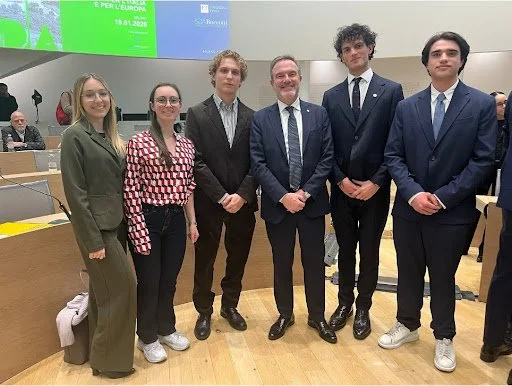
Members of the BOSDIC delegation attending the launch of SHIELD at SDA Bocconi.
On 19 January, a BOSDIC delegation took part in the launch of SHIELD (Strategic Hub for Integrated Education on Leadership and Defence) at SDA Bocconi.
SHIELD represents the first European academic hub dedicated to strategic analysis and research on the interconnections between defence, security, governance, economics and data science, applying an integrated approach to the study of current global geopolitical frameworks.
The objective of the project is to provide a clear and structured interpretation of the transformations reshaping the global order, enabling a multidisciplinary understanding of how governance and security dynamics affect economic and financial decision-making. In this sense, SHIELD aims to consolidate a stable synergy between academia, institutions and industry.
The multidisciplinary nature of the initiative is also reflected in the composition of the panel of speakers. Through the contribution of Professor Carlo Altomonte, Director of SHIELD, and SDA Bocconi Dean Stefano Caselli, an in-depth reflection emerged on the growing vulnerability of strategic supply chains related to goods and services critical to security. In this context, supply chains no longer represent merely an economic factor, but increasingly become central instruments of strategic competition and security, as also highlighted by the European Commission in its report on Strategic Dependencies and Capacities and by the OECD (Organization for Economic Co-operation and Development) in its analyses on the resilience of critical value chains. These vulnerabilities are further amplified by external shocks linked to the rising number of active armed conflicts worldwide (59 according to the Global Peace Index, the highest figure since the 1940s) and by the gradual strategic reorientation of the United States, which is reducing its role as an institutional, economic and military hegemon.
This scenario requires the European Union to reassess its diplomatic and security posture, in search of a sustainable balance between external challenges and internal stability.
Particular attention was devoted to the institutional remarks of the Honourable Antonio Tajani, Italian Minister of Foreign Affairs, who, in supporting the launch of SHIELD, emphasised that security can no longer be understood solely in terms of military defence. It increasingly encompasses critical infrastructures and supply chains, whose vulnerability can rapidly translate into strategic fragility.
This vision finds practical confirmation in the economic approach promoted by the Minister, aimed at strengthening the international projection of Italy’s productive system, with the objective of reaching €700 billion in exports by 2027 (Milano Finanza). The proposed strategy integrates economic growth with national security, highlighting how, in the current geopolitical context, economic and strategic dimensions are increasingly interdependent.
Within this broader reflection, the intervention of the Deputy Minister for Infrastructure and Transport, Edoardo Rixi, highlighted the importance of balancing logistics and security in international trade. His analysis underscored how the management of infrastructures such as ports and maritime communication routes constitutes a safeguard for both national security and economic activity. On this basis, the government representative responsible for infrastructure stressed the need to guarantee national sovereignty over territorial waters, while expanding exports and recognising the Mediterranean as a central hub of global trade. According to the Center for Strategic and International Studies (CSIS), China has implemented a global port-presence strategy, investing in critical infrastructures across key areas of the Mediterranean, the Middle East and much of Africa. The geopolitical relevance of Chinese investments derives from their strategic nature and their concentration on critical infrastructures. In this context, Rixi’s intervention emphasised the need for Italy to equip itself with a logistical and industrial governance framework capable of absorbing foreign investment without turning it into a source of dependency, maintaining openness to international capital while never relinquishing national sovereignty.
Following the Deputy Minister’s considerations on logistics as a material pillar of national security, the discussion moved to the institutional and diplomatic perspective of Alessandro Azzoni, Italy’s Permanent Representative to NATO, who framed these dynamics within the Euro-Atlantic security system. Italy’s senior representative to NATO explained that security cannot be fully guaranteed without sustained diplomatic engagement involving a plurality of states committed to defending shared principles in a uniform manner.
Azzoni recalled the central role of Article 5 of the North Atlantic Treaty as a cornerstone of collective deterrence, stressing that in the current context of hybrid threats, the protection of critical infrastructures and supply chains requires continuous coordination among diplomacy, alliances and operational capabilities, as the evolution of global frameworks is also transforming the very concept of conflict.
The discussion also touched upon the human dimension of diplomatic service, highlighting the responsibilities, personal burdens and sacrifices inherent in this profession, together with a strong sense of dedication and service to the State.
Alongside the diplomatic dimension of security, with its emphasis on alliances and the human value of diplomatic service, the reflection proposed by General Luciano Antonio Portolano brought the issue of defence back to a systemic and organisational perspective. From this viewpoint, security is not the result of isolated decisions, but the outcome of an integrated ecosystem in which institutions, armed forces and industry operate in a coordinated manner in the public interest.
Within this framework, Portolano emphasised the importance of returning to investment models capable of ensuring stability and continuity in production, moving beyond a purely emergency-driven approach to defence spending. The strength of the industrial base thus represents an essential condition for guaranteeing operational credibility, strategic autonomy and long-term responsiveness, as also highlighted by analyses from the Stockholm International Peace Research Institute (SIPRI), which underline the need for structured and resilient defence industrial systems to sustain states’ security commitments over time.
From this perspective, the intervention of Stefano Pontecorvo offered a concrete reading of the role that the defence industry can play within an integrated security ecosystem. Through the experience of Leonardo, the importance of interconnections between the public and private sectors clearly emerged, where public shareholding enables the alignment of industrial objectives with national security and international projection. Publicly owned companies, in this context, benefit from greater strategic stability and a long-term vision, elements that are particularly relevant in sectors characterised by high technological intensity and complex investment cycles.
Leonardo’s international operations, which generate approximately €3 billion in revenues in the United States (Leonardo S.p.A. Integrated Report), demonstrate how Italian industrial competitiveness is already embedded within the main global markets of defence and security. This figure suggests that the industrial dimension can also serve as a lever of credibility and international presence, reinforcing the need for Italy to assume a more central and aware role in economic diplomacy and global governance processes, in a context where industry, security and international relations are increasingly interdependent.
On this final point, the common thread running through the entire discussion was the recognition of the growing interdependence between the disciplines that regulate the life of a State, both domestically and internationally. Security, defence, economics, industry and diplomacy no longer operate in separate compartments, but influence one another, making an integrated reading of public policies essential. In this sense, SHIELD positions itself as a space for analysis in which internal governance and external projection of the State are considered inseparable dimensions, as decisions taken in economic, infrastructural or industrial domains produce direct effects on
national security and international credibility, and vice versa.
Pier Cianci is a first year Law student at Bocconi University.
